Finding My Voice
In June, I traveled to Montreal with my coauthor and friend, Mathias, to record the audiobook for The Intentional Organization. We had spent several years writing the book, revising chapters, debating ideas, and finding the right words to express what we wanted to say. Now it was time to read those words aloud, something I had been looking forward to but was also surprisingly nervous about.
I’ve never particularly liked the sound of my own voice. I had listened to enough audiobooks to appreciate how effortless a good narrator could make it sound, and I knew that reading a book aloud was very different from reading it silently to myself. I worried about sounding unnatural, stumbling over words, or simply not being very good at it. After spending so much time writing the book, I wanted to do it justice.
The recording studio was small, with a booth that was painted red just large enough for a chair, microphone, and an easel for displaying the manuscript. The owner was also our audio engineer and recording coach. He had a direct, reassuring way about him, which helped. We arrived a little bit late on our first morning, which was not our intention but we miscalculated the time it would take to rent and ride the city bikes to the studio. I was wanting a little time to get comfortable with the space before we started. Once it was my turn inside the booth, I put on the headphones, looked at the words on the screen, took a deep breath, and began reading.
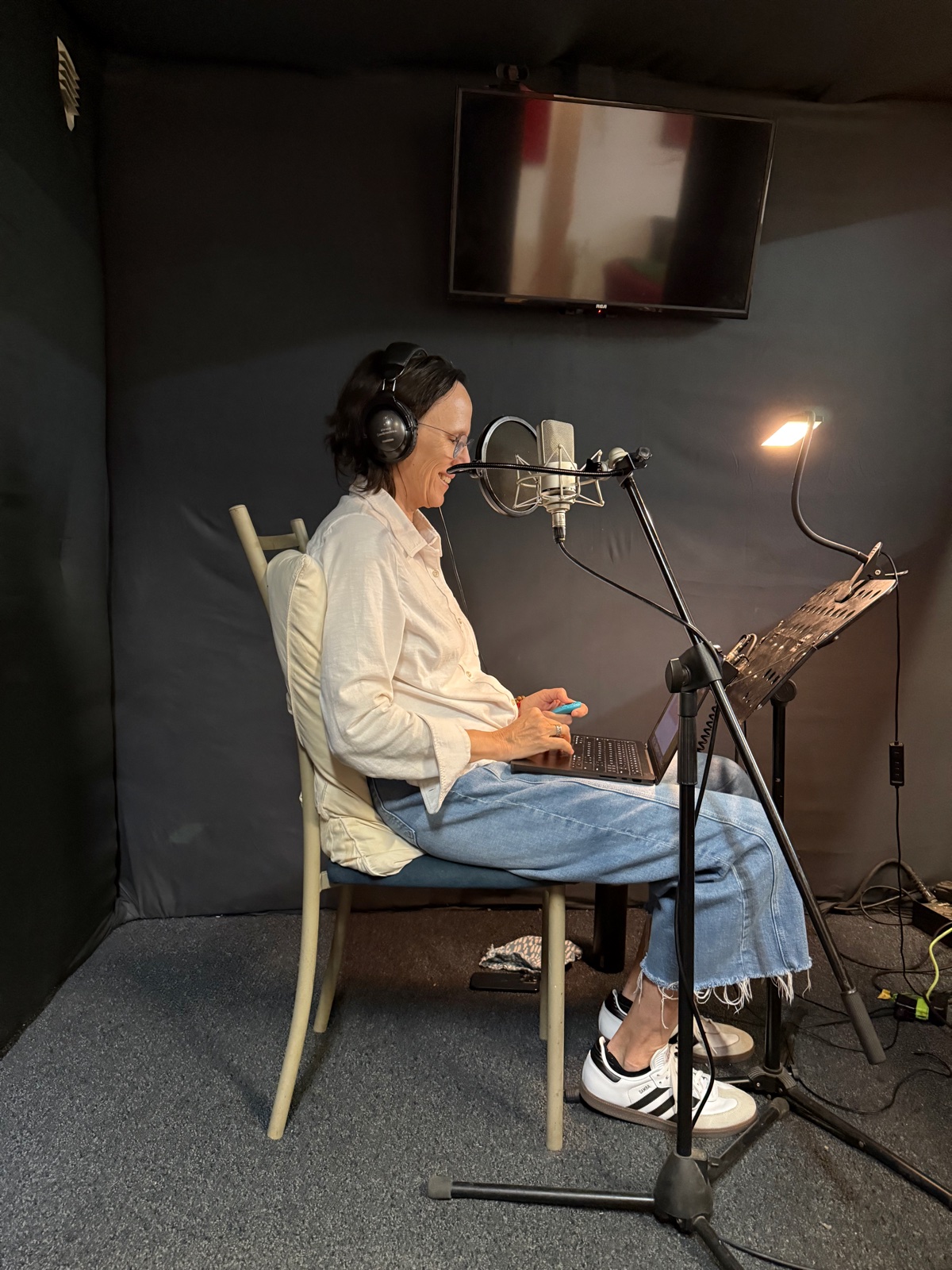
Hearing my own voice through the headphones was strange at first. Every hesitation, every breath, and every slight change in tone seemed amplified. I became aware of things I had never paid much attention to before, like the way I emphasized certain words, where I naturally paused, and how some sentences that sounded perfectly fine in my head felt awkward coming out of my mouth. “Who wrote that sentence,” I wondered, knowing it was probably me. It was difficult not to become overly conscious of how I sounded.
I was surprised by how vulnerable I felt. These were words I had helped write, ideas I believed in, and stories drawn from years of experience. Yet sitting alone in that booth, speaking them into a microphone, I felt exposed in a way I hadn’t expected. There was no audience to engage with, no conversation to respond to, and no presentation to guide me through what I wanted to say. I was simply reading, and listening to myself read.
The experience made me think about how much my relationship with my own voice had changed over the years. When I first became a founder and CEO, I wasn’t particularly comfortable being the person everyone looked to for answers. I had ideas, opinions, and convictions, but expressing them confidently, especially in front of a room full of people, didn’t always come naturally. I wasn’t someone who sought out opportunities to speak publicly, and I certainly didn’t imagine that one day I would be comfortable standing on a stage in front of thousands of people.
Running a company changed that. As a founder, I couldn’t avoid communicating. I was responsible for explaining our vision to employees, convincing investors to believe in what we were building, talking to customers, representing our brand, and making decisions that affected other people’s work and lives. There were all-hands meetings to lead, presentations to give, difficult conversations to have, and moments when I needed to stand in front of people and say something meaningful, even when I wasn’t entirely sure what the right words were.
At first, much of it was uncomfortable. I would prepare extensively for presentations and rehearse what I wanted to say, sometimes worrying more about how I would come across than whether I was communicating clearly. I was conscious of how others perceived me and whether I sounded confident enough to be taken seriously. But the responsibilities of being a CEO didn’t leave much room for avoiding situations that made me uncomfortable. I had to keep showing up, whether I felt ready or not.
Over time, I became more comfortable. I learned how to organize my thoughts, communicate with greater clarity, and hold my own in conversations that once would have intimidated me. I learned that I didn’t need to have every answer to be an effective leader, and that sometimes being willing to acknowledge what I didn’t know was just as important as explaining what I did. I also discovered that confidence wasn’t necessarily something I needed to feel before speaking. More often, it was something that developed because I spoke.
I don’t think I would have confronted so many of my fears if I hadn’t become a founder. The role demanded things of me that I might otherwise have spent my life avoiding. There were countless uncomfortable moments, some embarrassing and others genuinely frightening, but each experience made the next one a little easier. Eventually, I became someone who could stand on a stage, address a room full of people, and actually enjoy it. That would have been difficult for an earlier version of me to imagine.
For years, I had been learning to use my voice because other people needed to hear from me. Employees needed direction, investors needed confidence, and customers needed to understand what we were building. I was speaking on behalf of a company and the people who were part of it. That responsibility had pushed me to become a more capable and confident communicator, but it also meant that my voice was closely tied to my role.
Sitting in the recording booth was different. I wasn’t trying to persuade anyone, answer a question, or guide a team through a difficult decision. I wasn’t representing a company or trying to project confidence. I was reading words that Mathias and I had spent years putting together, allowing them to stand on their own. The responsibility was still there, but it was a different kind of responsibility. I wanted the words to sound like me.
As the recording sessions went on, I became less conscious of how I sounded and more focused on what I was saying. I began to find a rhythm. Some passages were easier than others, and occasionally a sentence would trip me up and we’d have to start again. Other times, I’d finish a section and realize I’d been so absorbed in the words that I’d forgotten about the microphone altogether. I started to enjoy the process, something I hadn’t been entirely sure would happen.
After years of writing and editing, the book was no longer just a manuscript on a screen. It had become something we could hear. Words that had been rearranged dozens of times were finally being spoken in the order we’d chosen, with the meaning we’d hoped to give them. Reading aloud also made me appreciate the writing in a different way. It exposed sentences that were doing too much work and ideas that weren’t quite as clear as we’d thought, but it also revealed moments when the words had a natural rhythm and a thought unfolded exactly as intended.
By the end of the sessions, I felt a mixture of relief, satisfaction, and a little sadness that it was over. What had initially seemed intimidating had become an experience I was grateful to have had. I enjoyed the challenge of learning something new, working with our recording coach, and hearing the book come to life. I was also pleased that I hadn’t allowed my discomfort with hearing my own voice to get in the way of the experience.
Looking back, I think recording the audiobook brought me back to something that had been developing for much of my professional life. I didn’t become a founder because I wanted to be a public speaker. I didn’t set out to become comfortable on stage, lead difficult conversations, or be the voice of a company. And I certainly didn’t write a book thinking I’d narrate the audiobook and start a podcast! Those were things I learned because the work required them of me, and somewhere along the way, the voice I had developed for the company became my own.
I still don’t always love hearing myself speak, and I’m not sure I ever will. But I’ve come to appreciate what that voice represents. It carries the years of uncertainty, practice, mistakes, difficult conversations, and small moments of courage that helped me become more comfortable expressing what I think and believe.
For much of my career, I had been learning to use my voice for other people. Recording the audiobook gave me an opportunity to hear it for myself. Sitting in that booth in Montreal, reading words I’d helped write, I was reminded of how far I’d come from the person who once dreaded being the center of attention. I wasn’t entirely comfortable hearing myself, but I was comfortable enough to keep reading, and eventually to enjoy it.
Perhaps that’s what finding my voice has meant for me. It hasn’t been about becoming a perfect speaker or eliminating every insecurity. It’s been about learning to trust what I have to say, becoming more comfortable expressing it, and recognizing that my voice belongs to me, whether or not I have a title or a company to represent.