Photosets and Learning to Share Again
For the past few weeks I’ve been quietly tinkering on something new for this site: a photos section. It’s not a portfolio or a feed. It’s a place for a single image or a small collection, with room for the story or memory behind it: a morning, a trip, a walk, a mood. You can spend a little time with the photos and the story, and then you’re done. There’s no infinite scroll, no algorithm deciding what you see next.
I didn’t realize how much I needed that shape until I started building it.
The pressure of performing
Somewhere along the way, sharing a photo stopped being about the photo. It became about the post. Will this do well? Is this the right one of the batch? Should I wait for a better time to share it? Every platform has quietly trained us to think about distribution before we think about the image itself, and photography, which used to be one of the most private, meditative things I did, started to feel like content.
I don’t think that’s a personal failing. It’s just what those systems are built to do. But it meant I was taking fewer photos I actually loved sharing, and holding onto more that I didn’t share at all, because the stakes of “will this land” felt disproportionate to a picture of a hillside.
A photoset is smaller than that. It’s not asking to perform. It’s just asking to be looked at, by whoever wanders in, on my terms, in my order. Here’s what I saw, and here’s the story of it, told in one frame or eight frames instead of eight hundred.
Where this all started
My dad is the reason I picked up a camera in the first place. I grew up going with him to the local camera store in Palm Springs, the kind of place that doesn’t really exist anymore, where someone behind the counter actually knew what you were asking about. We’d go out into the desert together to shoot, and there was something about that rhythm (walk, wait, notice, shoot, walk again) that I’ve been chasing in one form or another ever since.
Then there was the part I miss most: dropping off film and waiting to get it developed. That gap between taking a photo and seeing it wasn’t a flaw in the process, it was the process. You forgot half of what you shot. You’d be surprised by a frame you didn’t remember taking. There was no way to “check the shot” and retake it, so you learned to trust your eye instead of your screen.
From there the gear changed a dozen times over: different film formats, different bodies, the slow migration to digital, point-and-shoots, DSLRs, whatever phone I had at the time. Each shift changed how I shot a little. Digital gave me more freedom and, if I’m honest, also more distance. It got easier to take the photo and harder to sit with it.
The Leica problem
Eventually I got a Leica. I know. I know. On paper it should have brought me back to that slower, more deliberate way of shooting. That’s sort of the whole mythology around them. In practice, it’s done something a little different. It intimidates me. It’s manual in ways that make me second-guess myself, and there’s a strange psychological weight to using an expensive, storied camera in public. I feel like I need to justify pulling it out. I feel watched while using a thing designed for looking.
That’s a strange contradiction to sit with: a camera built for unhurried, intentional photography, and a shooter too self-conscious to actually be unhurried with it. I’m working on that. I think part of the answer isn’t about the camera at all. It’s about rebuilding a place where the photos can just exist without an audience calculating their worth in real time.
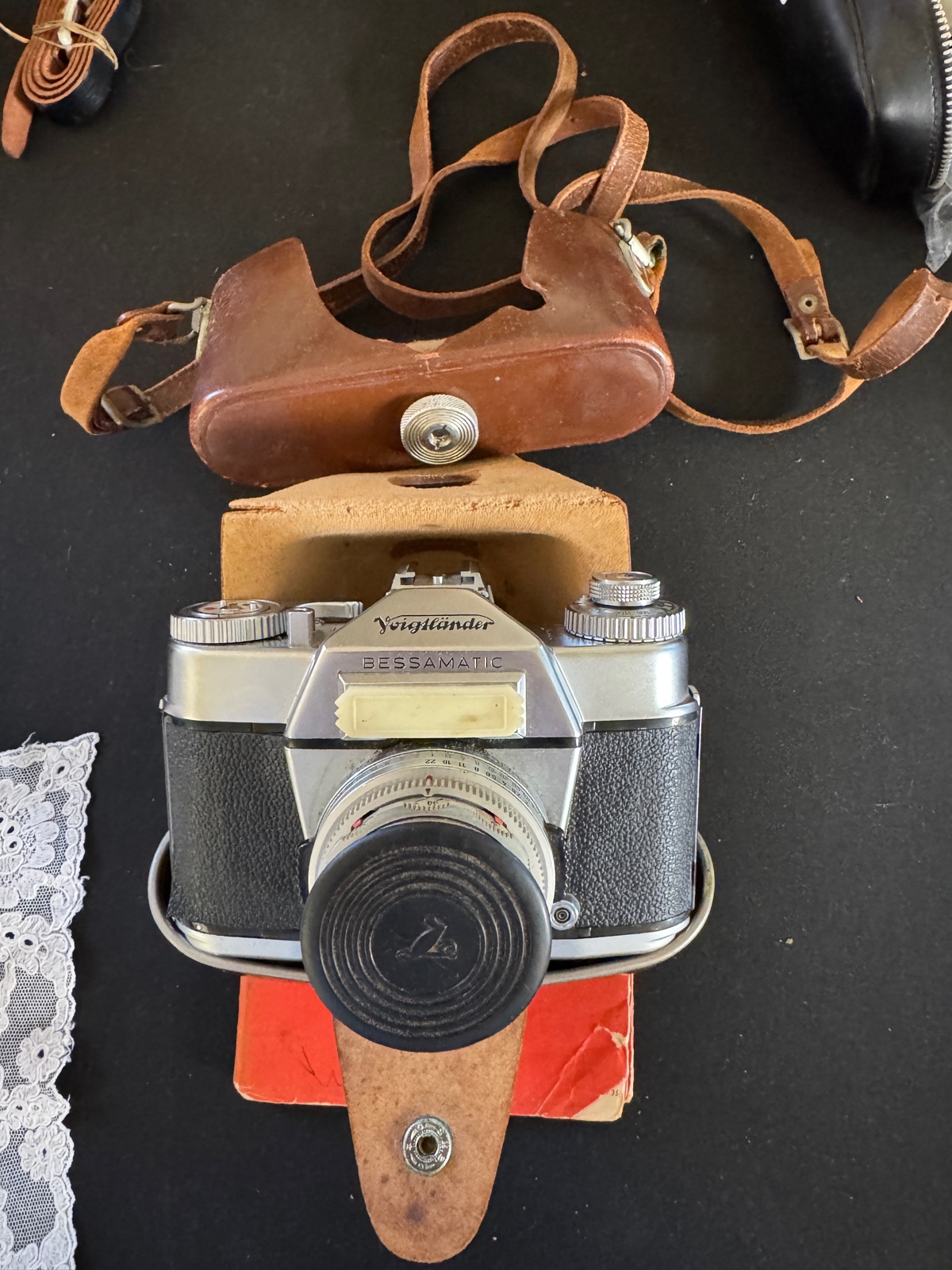
I also picked up a vintage Voigtländer Bessamatic film camera at a local estate sale for a steal. It’s intimidating in a different way. It’s from an era before my time, and I have to read the manual just to understand the basics. It’s heavy. They don’t make them like this anymore. If the Leica is about slowing down, this camera is almost as slow as you can go.
What I actually missed
If I’m honest about it, what I’ve been missing isn’t a platform or a format. It’s the photowalk itself: going out with no goal beyond noticing things, then sharing what I found the way you’d show a friend a stack of prints, casually, in person, without a caption doing the emotional labor of “this was a big adventure.” I miss being a photo nerd with a friend, walking, talking, and stopping every now and then to snap a pic, sharing for fun instead of for reach.
The fun part: building the thing
The unexpected upside of all this is that building this site has brought a version of that joy back. I even built a small Photo Studio app to manage, edit, and publish photosets without resizing and formatting every image by hand. It’s small and very scrappy, and I like it more than almost anything else I’ve built recently, precisely because there’s no audience for it either. It just needs to work for me.
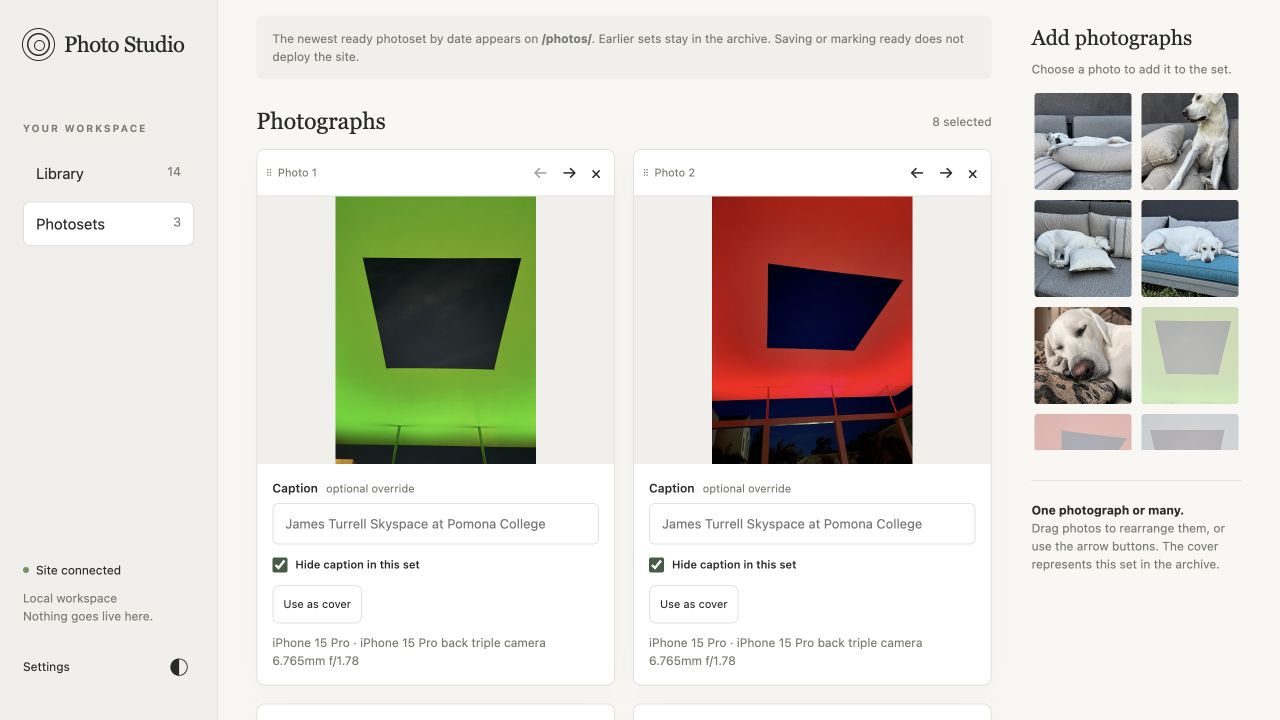
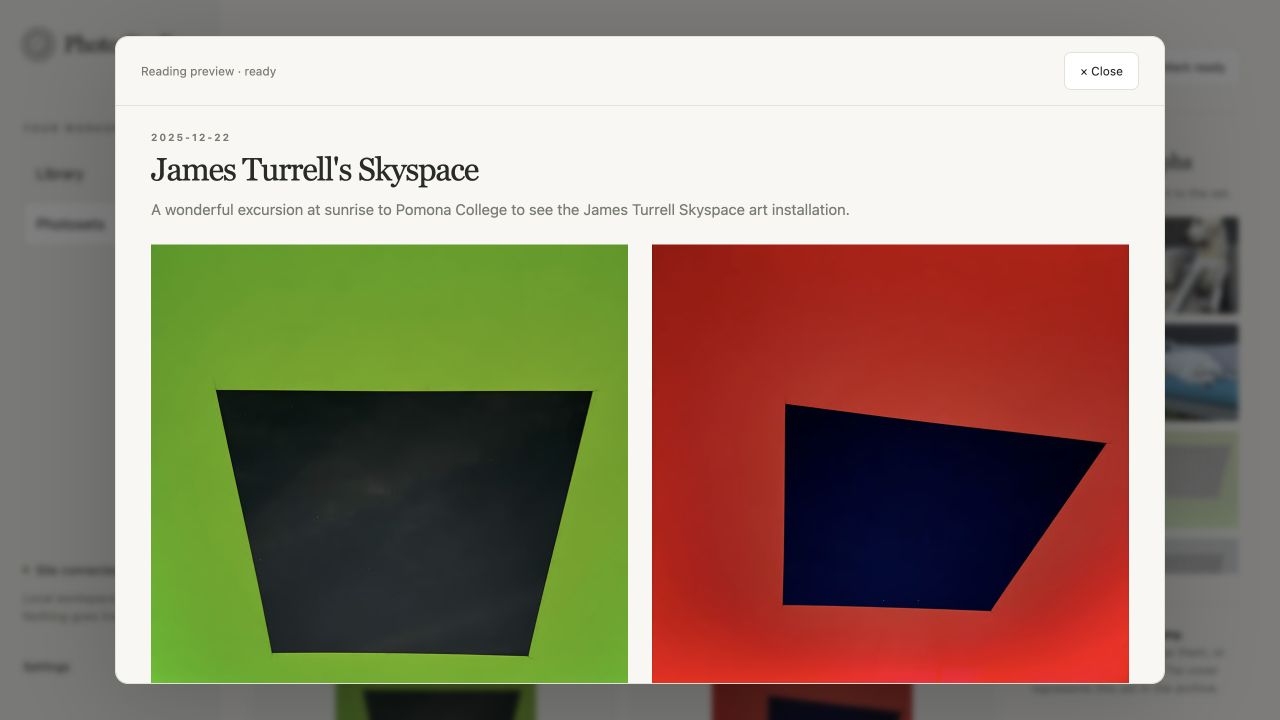
Building a place to share my photos ended up feeling like a photowalk itself: no deadline, just curiosity and the occasional surprise. That was the feeling I’d been missing. I plan to meet up with friends and do actual photowalks again, and now I have my own gallery to share the photos I like after the walk. That’s cool.
The photos section is live now. Start with James Turrell’s Skyspace, then wander through a set or two.
A special thank you to Paul Stamatiou and Small Hours, by the Boss, Jon Setzen for the inspiration. Their sites helped me imagine what a home for my own photos could look like.