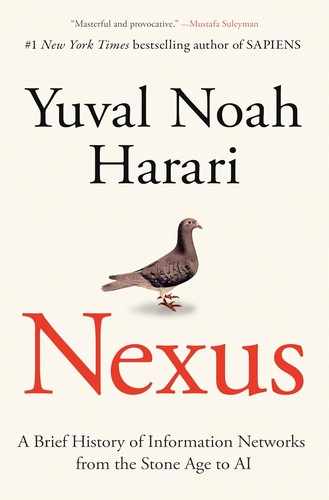
Nexus: A Brief History of Information Networks from the Stone Age to AI
Why I recommend it
I recommend this wide-ranging history of information networks for its insistence that information is not the same thing as truth. Harari traces how stories, documents, bureaucracies, mass media, and algorithms have helped societies coordinate at scale while also making surveillance, manipulation, and concentrated power possible.
What stayed with me
Information networks do more than transmit facts; they create shared realities, decide whose accounts count, and shape what institutions can see and do. The important question about AI is therefore not only what the technology can accomplish, but what kinds of networks, incentives, and accountability we build around it.
Who it’s useful for
Leaders, technologists, policymakers, and readers thinking about AI, media, institutional trust, and the relationship between information and power.
A tension or limitation
As with Harari’s other big-history books, the broad arc makes distant eras feel connected but sometimes compresses contested history and technological complexity. Its framework is most useful as a provocation to examine systems more closely, not as a complete account of them.